
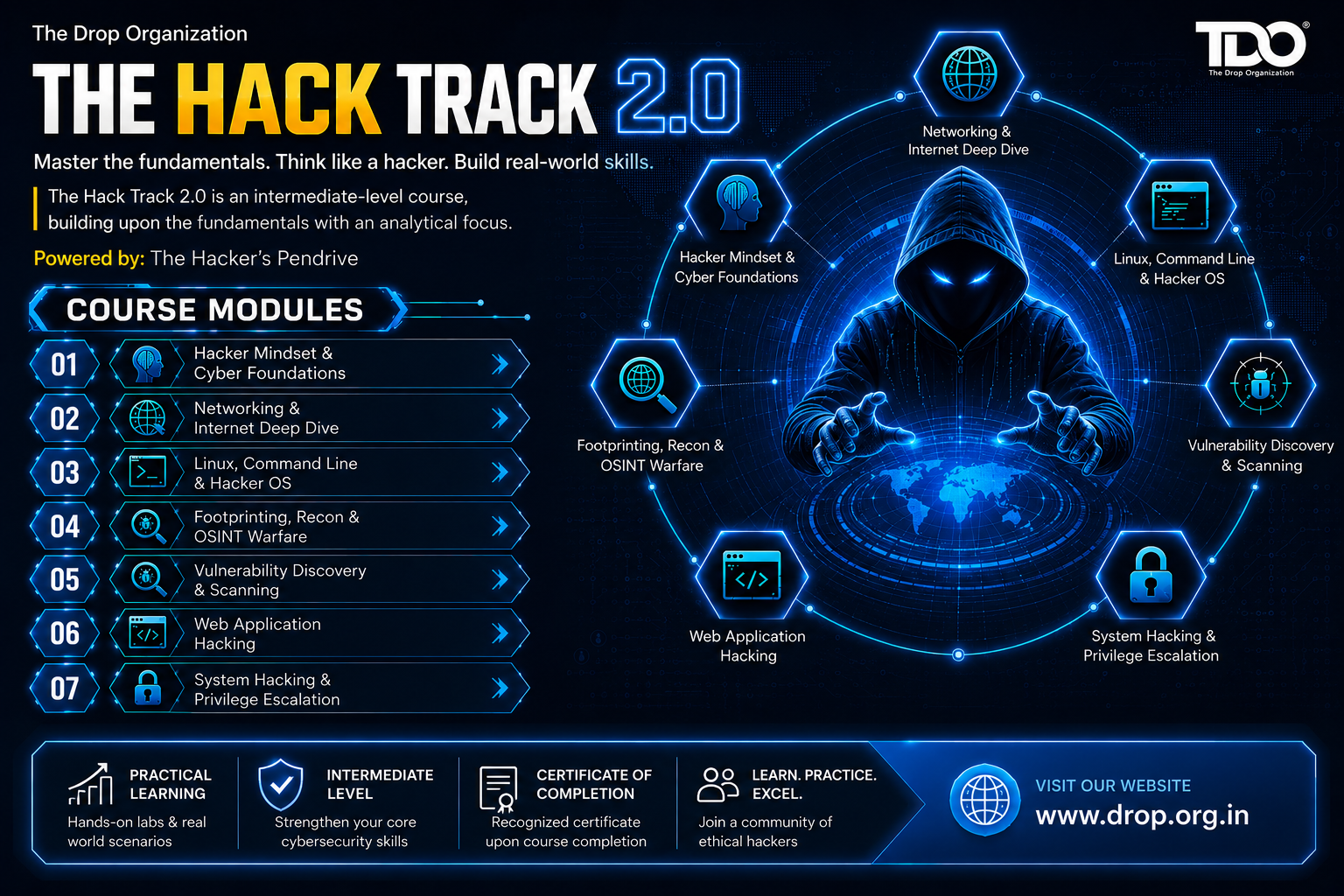
About Course
The Hack Track course is designed for those students who want so to start their learning from basic.
With Hacker’s Pendrive & 24/7 technical assistance from AI chat agent on LMS
Level – Intermediate
*Software Pendrive
*Certificate
Course Modules:
* Hacker Mindset & Cyber Foundations
* Networking & Internet Deep Dive
* Linux, Command Line & Hacker OS
* Foot printing, Recon & OSINT Warfare
* Vulnerability Discovery & Scanning
* Web Application Hacking
* System Hacking & Privilege Escalation
* Networking & Internet Deep Dive
* Linux, Command Line & Hacker OS
* Foot printing, Recon & OSINT Warfare
* Vulnerability Discovery & Scanning
* Web Application Hacking
* System Hacking & Privilege Escalation
What Will You Learn?
- Master the systematic, real-world workflow used by professional ethical hackers.
- Understand core networking protocols, internet traffic data flow, and packet analysis using Wireshark.
- Gain practical confidence navigating the Linux terminal and writing basic automation scripts in Bash.
- Conduct deep open-source intelligence (OSINT) gathering to map out a target's digital footprint.
- Systematically discover, scan, and assess system vulnerabilities using industry-standard security tools.
- Identify and exploit critical web application flaws based on the globally recognized OWASP Top 10 framework.
- Crack security hashes, execute local privilege escalations, and understand system exploitation methodologies.
Course Content
MODULE 1 — Hacker Mindset & Cyber Foundations
Module 1: Hacker Mindset & Cyber Foundations
Dive into the world of offensive security by adopting an attacker’s perspective. This module establishes the structural, technical, and ethical foundations required for ethical hacking.
What you will learn:
The Hacker Workflow: Master the systematic phases of a professional penetration test.
Threat Modeling & Attack Surfaces: Identify and map out digital vulnerabilities before threat actors do.
Industry Frameworks: Analyze real-world attack lifecycles using the Cyber Kill Chain and MITRE ATT&CK matrix.
Legal & Ethical Boundaries: Navigate cyber laws and compliance standards to ensure all hacking remains strictly legal.
Real-World Case Studies: Dissect historical breaches to understand real adversary tactics, techniques, and procedures (TTPs).
-
1. Ethical Hacking & Real-World Hacker Workflow
17:37 -
2. Hacker Types & Attacker Mindset (Black / White / Grey Hat)
17:04 -
3. Attack Surface Identification & Basic Threat Modeling
14:38 -
4. Cyber Kill Chain + MITRE ATT&CK (Attacker Perspective)
19:52 -
5. Cyber Laws, Legal Ethics & Compliance for Hackers
19:27 -
6. Thinking Like an Attacker: Real Cyber Attack Case Studies
14:10
MODULE 2 — Networking & Internet Deep Dive
Module 2: Networking & Internet Deep Dive
Master the backbone of the internet and modern digital communications. This hands-on module bridges the gap between networking fundamentals and defensive/offensive cyber concepts.
What you will learn:
Data Flow & Architecture: Discover how the internet functions through real request-response cycles, LAN/WAN configurations, and practical IP addressing (IPv4 vs. IPv6).
Core Protocols: Learn the mechanics of MAC addresses, ARP tables, DNS lookups, and secure vs. insecure web traffic (HTTP vs. HTTPS).
Traffic Control: Compare TCP vs. UDP behavior through real-world applications like chat, live video streaming, and gaming.
Packet Analysis & Scanning: Get an industry-standard introduction to traffic analysis using Wireshark and explore common ports, services, and network mapping basics.
Exploitation Foundations: Understand the structural gaps in networking protocols and look at beginner-level scenarios of how attackers target network weaknesses.
-
2.1 How the Internet Works (Requests, Responses & Real Data Flow)
19:00 -
2.2 Network Types (LAN, WAN, WLAN) with Live Examples & Home Lab Demo
-
2.3 IP Addressing (IPv4 / IPv6 / Public / Private) + IP Find Practice
-
2.4 MAC Address & ARP (ARP Table Viewing & Simple ARP Demo)
15:34 -
2.5 TCP vs UDP (Chat, Video, Gaming – Real Traffic Comparison)
19:32 -
2.6 Common Network Ports & Services with Scanning Preview
22:54 -
2.7 DNS, HTTP & HTTPS (Website Loading Practical Flow)
-
2.8 Packet Analysis with Wireshark (Capture Your Own Traffic)
20:24 -
2.9 Network Scanning & Mapping (Basic Recon Concepts)
17:43 -
2.10 How Hackers Exploit Network Weaknesses (Beginner Scenarios)
MODULE 3 — Linux, Command Line & Hacker OS
Module 3: Linux, Command Line & Hacker OS
Build your terminal proficiency and master Linux, the ultimate operating system for security professionals and ethical hackers. This hands-on module transitions you away from a graphical interface into a powerful command-line environment.
What you will learn:
* The Hacker OS Environment: Explore why security professionals rely on Linux and complete a full, hands-on installation and configuration of Kali Linux.
* Architecture & Navigation: Demystify the Linux file system structure and learn how to confidently navigate and manipulate data directly through the terminal.
* Permissions & Access Control: Master user accounts, group dynamics, and strict file/folder privilege settings—crucial components for privilege escalation testing later.
* Git & Tool Management: Install, configure, and use Git/GitHub alongside package managers to clone repository tools and install industry-standard security software.
* Automation & Scripting: Learn essential terminal commands and take your first steps into beginner Bash scripting to automate repetitive tasks and speed up workflows.
-
3.1 Why Hackers Prefer Linux
18:38 -
3.2 Kali Linux Installation & Setup
15:58 -
3.3 Git & GitHub Install, Setup & Usage
15:19 -
3.4 Linux File System Structure
16:11 -
3.5 Users, Groups & Permissions
15:58 -
3.6 Essential Linux Commands for Hackers
10:57 -
3.7 Bash Scripting (Beginner Automation)
12:05 -
3.8 Package Managers & Tool Installation
09:06
MODULE 4 — Footprinting, Recon & OSINT Warfare
Module 4: Footprinting, Recon & OSINT Warfare
Master the art of information gathering and Open Source Intelligence (OSINT). This module teaches you how to map out a target’s digital footprint and uncover hidden intelligence using completely legal, publicly available data resources.
What you will learn:
* Reconnaissance Strategy: Understand the critical differences between active and passive footprinting methodologies.
* Domain & DNS Intelligence: Learn techniques for WHOIS lookups, DNS enumeration, and discovering hidden subdomains.
* Advanced Search Exploitation: Leverage Google Dorking tactics and utilize Shodan to track down exposed, internet-connected infrastructure.
* People & Asset Tracking: Conduct deep intelligence gathering across social media platforms, emails, usernames, and document metadata.
-
4.1 Footprinting & Reconnaissance Overview
08:24 -
4.2 Passive vs Active Reconnaissance
16:01 -
4.3 WHOIS & Domain Intelligence
17:40 -
4.4 DNS Enumeration Techniques
19:48 -
4.5 Subdomain Discovery Methods
16:33 -
4.6 Google Dorking & Search Exploitation
13:59 -
4.7 Shodan Basics for Recon
17:18 -
4.8 Social Media OSINT Intelligence
14:18 -
4.9&4.10 Email, Username, People Tracking + Metadata & Document Intelligence
09:24
MODULE 5 — Vulnerability Discovery & Scanning
Module 5: Vulnerability Discovery & Scanning
Transition from gathering information to actively identifying security gaps. This module focuses on using industry-standard scanning tools to systematically detect, evaluate, and document system weaknesses.
What you will learn:
* Vulnerability Frameworks: Learn how security gaps are categorized and prioritized using CVE records and CVSS scoring systems.
* Advanced Infrastructure Scanning: Master network discovery, port auditing, and service version enumeration using Nmap.
* Automated Security Tools: Gain practical experience with automated web and system scanners like Nikto, OpenVAS, and Nessus.
* Reporting Foundations: Compare automated vs. manual assessment techniques and learn how to draft actionable vulnerability reports.
-
5.1&5.2 What is a Vulnerability + Vulnerability Types Explained
13:42 -
5.3 CVE, CVSS & Vulnerability Databases
12:41 -
5.4&5.5 Nmap Basics to Advanced Scanning + Service & Version Enumeration
22:55 -
5.6 Nikto Web Scanner
19:48 -
5.7 OpenVAS Vulnerability Scanning
41:51 -
5.8 Nessus Scanner Overview
-
5.9 Automated vs Manual Testing
10:03 -
5.10 Vulnerability Report Writing (Beginner Friendly)
38:33
MODULE 6 — Web Application Hacking
Module 6: Web Application Hacking
Dive deep into the mechanics of web security. This comprehensive module focuses on understanding how modern web applications operate and how to find and exploit the industry's most common flaws.
What you will learn:
* Web Architecture: Understand the fundamental technologies driving modern web applications and APIs.
* The OWASP Top 10: Explore the industry-standard benchmark for critical web application security risks.
* Core Vulnerabilities: Master major exploit vectors including SQL Injection, Cross-Site Scripting (XSS), CSRF, IDOR, and File Upload flaws.
* Intercepting Traffic: Get hands-on experience using Burp Suite to analyze, modify, and exploit live web traffic.
-
6.1 How Web Applications Work
-
6.2 OWASP Top 10 Overview
11:12 -
6.3 SQL Injection (Manual + Tools)
15:43 -
6.4 Cross-Site Scripting (XSS)
10:10 -
6.5 Cross-Site Request Forgery (CSRF)
-
6.6 Authentication & Session Attacks
-
6.7 IDOR & Access Control Flaws
-
6.8 File Upload Vulnerabilities
-
6.9 Command Injection & RCE Basics
-
6.10 Burp Suite Basics + Exploit-DB Usage
17:30
MODULE 7 — System Hacking & Privilege Escalation
Module 7: System Hacking & Privilege Escalation
Learn how threat actors compromise systems, crack defenses, and escalate their control over local networks. This module provides a direct look into system post-exploitation and privilege management.
What you will learn:
* System Compromise Methods: Step through the complete system hacking methodology, from initial access to data collection.
* Credential Warfare: Learn the mechanics of password hashes and use powerful tools like John the Ripper and Hashcat to crack them.
* Privilege Escalation: Learn how to audit Windows and Linux configurations to escalate your access from a standard user to Administrator or Root.
* Payloads & Persistence: Generate custom payloads using MSFvenom, understand malware concepts, and study entry-level Windows Defender bypass strategies.
-
7.1 System Hacking Methodology
-
7.2 Password Attacks & Hash Basics
-
7.3 Password Cracking (John & Hashcat)
-
7.4 Windows Enumeration Techniques
14:40 -
7.5 Linux Enumeration Techniques
-
7.6 Privilege Escalation Basics
-
7.7 Windows Privilege Escalation
-
7.8 Keylogging & Spyware Concepts
13:29 -
7.9 Malware, Payloads & msfvenom
-
7.10 Windows Defender Bypass (Intro Level)
Student Ratings & Reviews

No Review Yet